Tuesday, April 26, 2016

Promaster Build- Mostly complete!

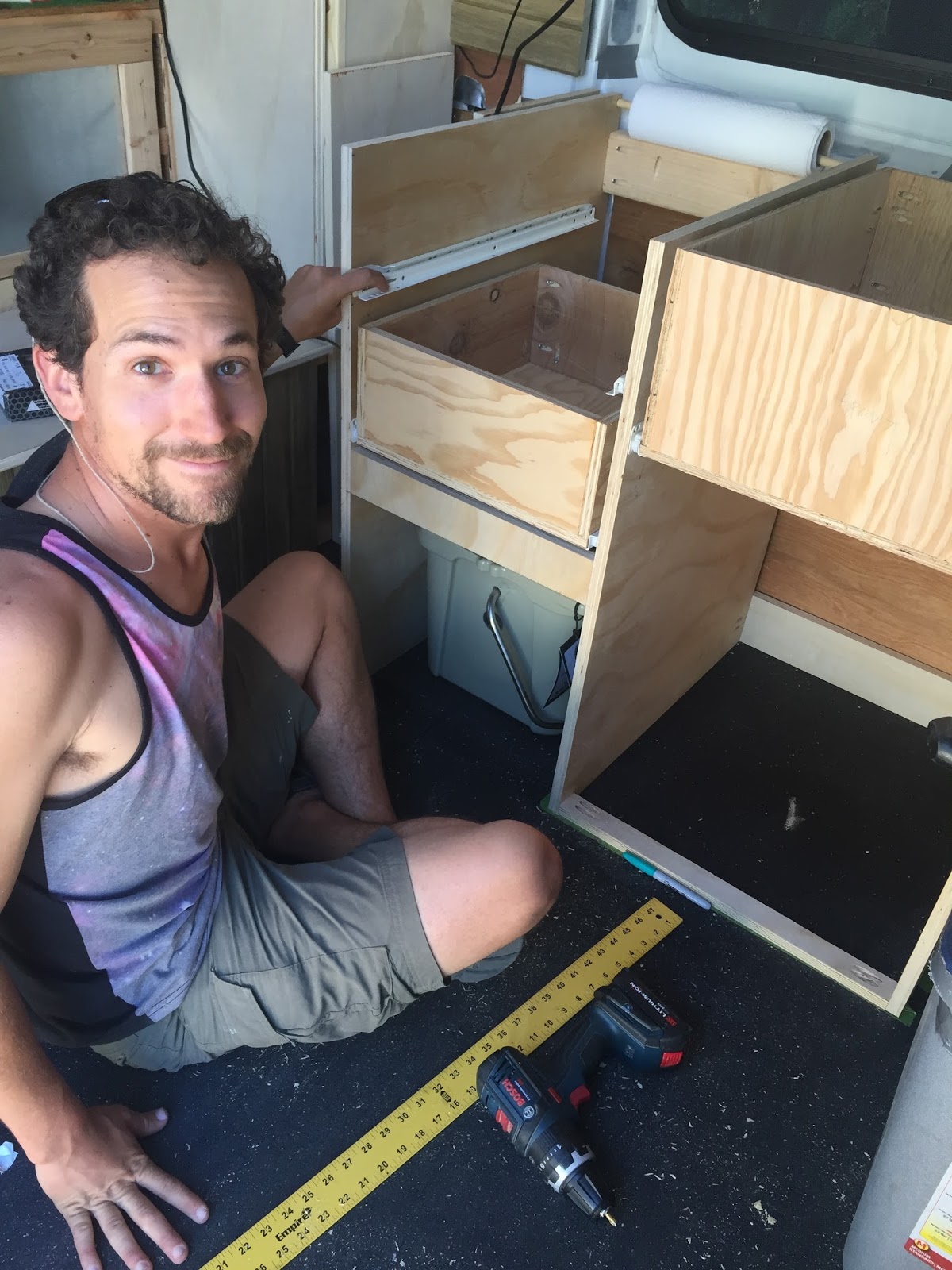
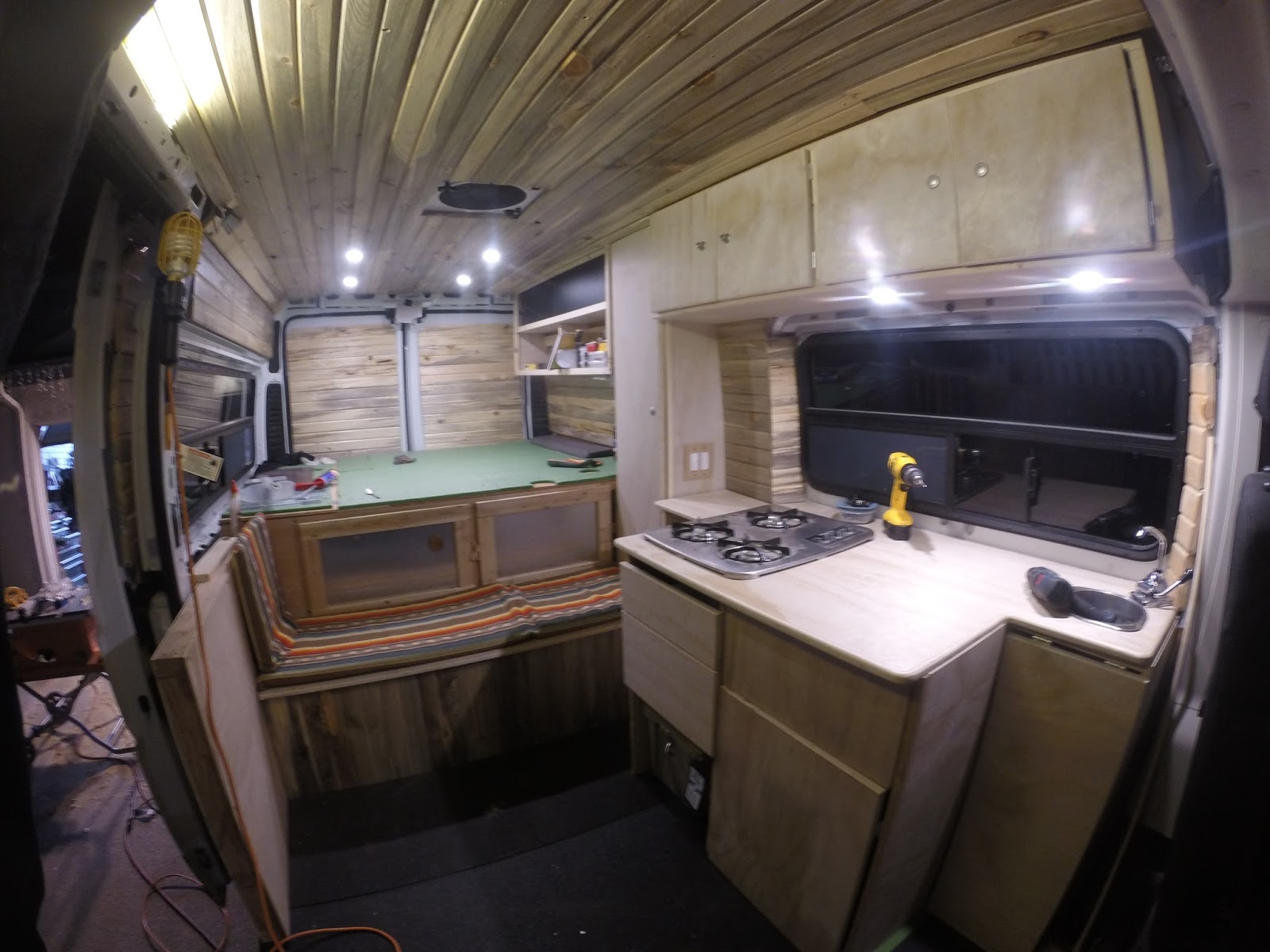
Due to trips and work obligations (ha! maybe the first time I've said that), we had a very small window of time to build the van.  We were able to get the van mostly done in 10 days of hard work.  Thankfully, we had my brother on board to help.  He is an engineer, owns every tool ever made, and is good at everything.  He was indispensable on this project.  The only major project we didn't complete was installing our wood stove, which will have to wait until this winter.  Hopefully it won't be too cold in between now and then!  When I built out Silas, I did it as quickly and cheaply as possible.  We put a lot more money and effort into Pedro.  I thought the Sprinter was tricky because of the curved walls, but boy the Promaster is SO HARD to work in.  There is not one straight line in there, no square walls, and no flat spots that don't have random bumps.  We tried to pre-plan how we built everything, but ended up just making everything up as we went along to accommodate all the weird shapes and things that we had to work around.  Here is the basic process:

Day 1: Windows.  You can check out my previous blog for more details on installing the windows.


Day 2: Planning and bed frame.


 Day 3: Framing of pony wall (eventual location of wood stove), bench


 Day 4: Frame up of tall cabinet


Day 5: Over-bed cabinet which is a bookshelf and slider cabinet


Day 6: Kitchen cabinets


Day 7: Doors and latches on cabinets, initial kitchen frame, begin siding, air-tight propane cabinet


Day 8: Drawers installed under bed and faced with steel, more siding installed, kitchen drawers built


Day 9: Install the rest of the siding, all electrical, kitchen counter, backsplash


Day 10: Finish up odds and ends and hit the road!

Completed van pictures in the next post!

Thursday, April 14, 2016

Promaster Build- Window Installation

Today we installed the windows in the Promaster.  Much to my surprise and delight, it was EASY!  We went back and forth between deciding to have these installed by a professional and trying to do it ourselves.  My mom pushed strongly for the professional route.  I emailed several van outfitters and got a reply from one who quoted me $495 per window.  That was a little out of the budget, so after watching some videos and reading up on window installation, we decided it seemed straight forward enough to do it ourselves.

Materials:
Ram Promaster 159-2 window from Motion Windows
Ram Promaster 159-3 window from Motion Windows
Exterior seal tape (included with windows)
Screws (included with windows)
Cardboard, tape, sharpie, measuring tape, scissors (for template)
White paint
Jigsaw with fine-toothed blade
Sander
Flathead screwdriver
Hammer
Drill

Steps:

1. Draw your template.  We found a big piece of cardboard and traced along the part of the window that had to fit through a hole.  Cut out the cardboard.

2. Remove support bars.  The Promaster comes with metal supports between the big panels.  They don't seem super important and were obviously in the way of the windows, so we took them out.  We used a flathead screwdriver and a hammer to kind of chisel them out.

Big thanks to my brother for all his help!


3. Transfer template to van.  We wanted our windows to sit as high as they could in the space we had, so we measured the interior clamp ring and positioned our window accordingly along the top edge.  We also measured the panel and marked the middle, and then it was easier to line our template up in the middle of the space, with equal edges on both sides.  We taped it on and traced around it with a sharpie.  We traced and checked our template a billion times for the first window because we were really nervous.  This is a good time to measure twice, cut once.  


4.  It is not possible to cut the whole window from inside the van because your jigsaw will run into things, so you will have to transfer your template to the outside of the van.  You can do this by drilling holes along your traced line, then going outside the van and lining your template up with the holes.  Trace it on the outside.


5. Protect your paint.  If you're not lazy, you will want to tape around your lines with painters tape so the jigsaw won't scrape your paint while you cut.  If you are lazy, you can just tape the bottom of your jigsaw and hope for the same effect.

6.  Drill and cut.  Drill a hole so you can get your jigsaw blade in there.  Cut out along the lines.  If you are cutting a big window, the piece will get really wobbly and you will want to tape it in place or have someone hold it steady.


7. Dry fit the window and trim any edges if necessary.

8. Paint any raw exposed edges to prevent rust.

9. Install your window according to manufacturer's instructions.  For our particular windows, we didn't need to build a frame or anything.  We just applied the seal tape to the edge of the window, and popped it into place.  Then had one person go inside the van and screw on the interior clamp ring.  EASY PEASY!


I am super happy with how the windows turned out.  They look AMAZING.  Both windows are sliders with screens so we will have awesome ventilation and no bugs.  They came with a really nice dark tint so people won't easily be able to look inside.  The sliders lock, and the windows feel really sturdy and durable.  The smaller window will be above the kitchen and the large window is in the bed area.  The large window is reallllllllly big, but I think we are going to be extremely happy with it.  These windows were pretty pricey, but it was definitely worth it!  Motion makes windows specifically for all different types of vans- Sprinter, Promaster, Transit, so you know they're going to fit.  They are slightly curved to go with the side of the van.  Keep in mind, these take 6+ weeks after ordering to arrive, so plan ahead!


Wednesday, April 13, 2016

Van Smog Problems- Help!

HAAALLLLLPPP!  As per usual when life throws me a tricky situation, I turn to the Internet for help.  Here I am with the latest and greatest trial and tribulation of van ownership.  I thought buying a new van would free me from mysterious problems, but alas my luck follows me from van to van.  I will try to summarize this in the briefest and clearest way possible and if you have any experience in this department, I would love to hear your advice.

In January, I bought a semi-used 2014 Ram Promaster 3500 Cargo van from Reno Dodge.  It was being used as their parts vehicle and they sold it to me for a great price, removed the decals, and sent me home with a brand new looking van with 17,000 miles on it.  Everything was going well until I tried to smog it so I could complete my California registration.  It failed smog due to the presence of three incomplete monitors.  What does that mean?  When you reset a check engine light or disconnect your battery, the computers in your car have a whole bunch of tests they will run through to make sure everything is ok with all sorts of different components of your vehicle.  These tests take varying amounts of time, mileages, or types of drive cycles to complete.  One of the issues with these tests, is that no one really seems to know how to complete them.  For example, some of the monitors may complete after 250 miles.  Some after x amount of drive cycles, and some after specific types of driving- highway, city, stop and go, idling for a certain amount of time at certain engine temperature.

After I failed smog the first time, we determined that I needed to drive more because the check engine light had been reset right before I bought the vehicle after a part had been replaced.  So I drove more, failed, drove more, failed, drove more, and failed again.  At this point I had driven 5,000 miles and was beginning to think that driving more was not the solution.  I tried to get the van in to the dealer before we left for our ski trip, but they said they couldn't fit me in.  We went on the trip, adding another 2-3,000 miles to the van.  Midway through the trip we stopped at Dodge in Salt Lake for an oil change.  I asked them to see if we still had incomplete codes and they told me my PCM (some time of computer) needed to be replaced.  A solution to the mystery!  I was satisfied knowing this was under warranty and that when we got back from our ski trip we would breeze into the dealer, get our new computer, pass smog, and get our license plates.

A breeze it was not.  Because I needed to be mobile during the week after we got back, scheduling was very difficult.  I talked to a total of 8 different Dodge dealerships and either they didn't work on Promasters (um, what.) or they couldn't get me in until a week or two out.  Finally, I put my foot down and told Reno Dodge I was coming in first thing Monday.  Doing this meant sacrificing being in the Bay Area to pick up Brian when he returned from Taiwan after a two week trip, but it seemed like the only time I could squeeze this in to our timeline, and it needed to get done.

At the dealer, it was determined that the PCM was not the issue.  Chrysler HQ tech support was contacted and a case was started.  After leaving the van there for two days, I picked it up and was told that it was a known issue, but there wasn't currently a fix for it.  Apparently something was tried that might work, but there wouldn't be a way to know for sure until I had driven it a bit.  I drove to Truckee, but arrived just after 5 so I couldn't try getting it smogged.

I drove down to the Bay to pick up Brian and we decided to increase our odds of success by trying to smog the car during a long drive cycle, as was suggested by Carson Dodge earlier in the troubleshooting process (they told me to drive from Truckee to Sacramento and back to Truckee without stopping and then smog the van without turning it off, but I had better things to do).  We drove 210 miles straight to San Luis Obispo and into a smog shop.  We didn't turn off the van.  We plugged in the scanner.  And we had FIVE incomplete monitors.  FIVE!  So not only did taking the van in not help at all, it actually increased our number of incomplete monitors.  In theory, two of them will probably test out eventually as they apparently did before, but I'm guessing that at least three are there to stay.  Here's where you come in and answer my fun multiple choice question!

What do I do?

a) I've been told by someone at the smog shop and someone at CA DMV to take the van back and tell them to give you a new one.  

While this sounds like a good option in theory it is problematic right now because 1. This problem is not isolated to just my van, but has been showing up in several Ram engines and in other Promasters and could occur in a new van as well and 2. Today is April 13 and I need to be in Alaska with a completely built out van by May 1, so disassembling the work I've done thus far, driving back to Reno, getting a new van, starting over from scratch, building it, and driving to Alaska in 17 days?  Not going to happen.

b) Try to register the van in another state with different smog requirements.

Brian has a Washington address, we technically still have a Nevada address, and we have friends in Wyoming, which requires no test at all, we will also be in Alaska this summer, which also doesn't require a test.  If we do attempt to register the van in another state, it is possible that we will have to forfeit the money we have already paid to the CA DMV.  In addition, we will have to cancel our current insurance policy and start a new one.

c) Continue getting extensions on our temporary operating permit in CA until...

CA gave us 60 days to pass smog.  This expires on the 25th.  If we haven't passed by then they will give us an extension.  How many extensions you can have I don't know.  Regardless, we will be in Alaska until September, so we risk getting a ticket/fine/thrown in jail/who knows for having an expired temporary operating permit if we get pulled over up there.

d) Get some kind of exemption or temporary relief from having to pass smog

If anyone knows if this exists, please tell me ASAP!  I know when I was out of state for about a year, I got to delay my CA smog check on my last van.  If there is anyway to at least get our license plates without passing smog, that would be a great solution, even if we have to try again and go through this all again next year.

e) Fill in the blank.  Thoughts?  Ideas?

Basically, it would be great to have license plates and it would be great to know that we will be able to cross the border into Canada and then back into Alaska without problems.  Whether or not we will have problems with our current plate-less vehicle, I don't know.  Well, so much for brevity.  If you're still with me and have any thoughts or experience in this field, let me know!

Friday, April 8, 2016

Backcountry Basics


My goal for this winter was to spend the season in Tahoe and learn how to backcountry ski.  As I begin transitioning to the summer season and reflect on the winter, I think it is safe to say that I have accomplished my objective.  It isn't terribly hard to motivate oneself to learn how to do something that is fun and rewarding, but still, I feel good about how things went.

Birthday turns outside the Bradley Hut.  Photo by Brian Buckley
One of my favorite backcountry partners
 Learning to backcountry ski consists of obtaining your new gear and finding out how it works, and very importantly, figuring out how to travel safely in backcountry terrain to avoid the risk of avalanches.  Buying the gear was extremely fun, although wildly expensive.  Because I'm a bit small, I wasn't able to find a used set-up that would work for me.  I said to hell with saving money and went all out on some really nice gear.  It helped to go to a local ski shop where one of the employees listened to what my goals were, what type of skier I was, and what I was looking to do.  I walked out with a set-up that I'm extremely happy with.  You can see my gear list at the bottom of this post.  On to education!


At first, I was adamant that I would not go into the backcountry without first taking my Avy 1.  However, things didn't really go according to my original plan, and in hindsight, I'm glad they didn't.  I was fortunate to have two experienced backcountry travelers as roommates (one of which was my boyfriend, he's super cool).  They both knew my skills (or lack thereof) as a skier and took me under their wing to teach me the ways of the world.  Brian took every opportunity to point things out to me- terrain traps, cornices, wind features, and he took the time to dig some pits with me to teach me about the layers in the snowpack.  He taught me how to read the avalanche forecast, how to chose safe terrain, and how to travel as a group both on the way up and on the way down.  He gave me tips on skinning and tried mightily to give me skiing tips, which I successful ignored.  I was also fortunate to go on one of my earlier tours with my ski idol, Hutch.  This was helpful because she is actually a skier, not a splitboarder, and she's a badass, so she gave me lots of excellent tips as well as a bit of confidence.  Aside from learning about terrain, I learned about my safety equipment and how to use it.  There were lots of great events around Tahoe this winter, including an informative seminar on beacons, which I went to to familiarize myself with how they work.

Surface hoar.  Very pretty, but very dangerous if it gets buried.
Titan and Brian digging a pit
I ended up taking my Avy 1 in March, after I had about 25-30 tours under my bibs.  The reason that I'm glad I waited, is that I found all the information much more valuable after having experience seeing terrain, reading the forecast, evaluating conditions, and observing snow and how it reacted as I was in the backcountry.  I also already knew how to use my equipment, so I wasn't distracted by trying to figure out how to skin, transition, use my shovel, etc. during my class.  The most valuable part of the class for me was the beacon practice.  Although I had talked about doing more beacon practice during the season it never really happened, thus the forced practice was great and made me a lot faster.


Tahoe was the perfect place for me to begin this new facet of skiing.  There is so much skiing that is so accessible, and so much of it is nice low angle terrain.  As much as people don't believe me when I tell them this, I am NOT good at skiing.  I only began skiing about five years ago, and before this season I think my record was maybe 30 days in one season.  So it's safe to say I had well under 100 days of skiing experience going into this season.  I got into backcountry less so for hardcore skiing and more so because I like the whole experience of traveling in the backcountry, getting fresh tracks, and being able to ski with my dogs.  What I didn't expect was how much I would fall in love with it.  Winter has always kind of been an 'eh' season for me (unless I'm out in the desert climbing and it's not actually wintry), but after this year, I can see winter becoming 'the' season for me.


I am looking forward to moving up to Skagway in a few weeks and being able to tour into the summer months.  I feel like a whole new world has opened up to me, and I can no longer pass a snow covered slope without thinking about skiing it. It's amazing how much my focus has shifted from climbing over the past few years, but there are so many activities out there and I want to try them all!  I can't imagine much better than fresh, weightless turns with my dogs bounding down behind me.


Gear
I really like gear.  It was exciting to begin a new activity where I was required to get lots of new stuff!  Here is my gear list for this season:

Skis
Line Soulmate: I don't know much about skis, but I know these ones are sure pretty. 

Dynafit
Neo PX CR boot: Comfiest boot ever.  Right out of the box these things fit like a dream.  From day 1, I've never had any blisters or unconfortable rubbing.  Super light weight.  I can wear these all day, no problem.
TLT Radical binding: Practice transitioning your binding back and forth a few times before you get out in the field, and you'll have these things under control in no time.  Really light and simple. 

Backcountry Access
Float 22 Pack: Overall, I really like this pack and the way the pockets are organized, with a separate pocket for your probe and shove, and a helmet spot.  I wish you could choose which side your airbag deployer was on, like on the 32L pack.  This pack is great for day tours, but not big enough for multi day trips.  It seemed to have a 'manly' fit on me, wide in the shoulders, I really had to cinch it down to get it to stay on right.
Shovel: Pretty standard and shovely.  
Stealth 270 Probe: If possible, practice deploying probes in the store and find the one that is easiest for you to use.  This things snaps together really quickly and I'm happy with the length.
Tracker 2 Beacon: Really simple and intuitive.  I like this beacon a lot.

Black Diamond
Big ol Mittens: Not the official name, but my hands get really chilly so I like these fluffy mittens.
Little Skinning Gloves: Also not the real name but I've found my hands sweat too much in my mittens to skin with them, but they are often too cold with out mittens, so these liners keep me happy.
Skins: Yup.  An important part of the equation!

Smith
Maze Helmet: Lightest helmet on the market.  Need I say more?
IO/S Goggles: Made for smaller faces.  No gaper gap.  Superior anti-fog technology.  Reallllllly easy lens transitions.
Lowdown Slim Sunnies: I love these sunnies for skinning (and life) and because they are 'slim' they don't fall off my face.

Clothes
Patagonia Pow Slayer bibs: As long as you don't have to pee too often, these bibs are awesome!  I didn't realize how dirty this cool yellow color would get, so I would suggest a darker pair.  Good pockets.
Columbia Midweight Stretch Baselayer Tight (not pictured): These are bright pink and shiny on the inside! 
SmartWool PhD Ski Ultra Light Sock: The best ski sock there is.  Or so I think.
Outdoor Research Ferrosi Softshell Hoodie: I don't have an official ski jacket so I usually wear this as my skinning jacket until I get too hot and take it off, then I put it back on with an insulated layer on top.
First Ascent BC MicroTherm Storm Down Jacket (not pictured): This jacket is badass.  It's warm, it's down, it's water resistant, and it fits super right.  
Outdoor Research trucker hat: Keep the sun off the snoz.
Big Truck bucket hat: Really keep the sun off on those super sunny days.
Buff: Never leave home without it.  I wear a buff 100% of the time when skiing, whether it is freezing or super hot.